
Sweden

Total Installed capacity

Year

2002

2003

2004

2005

2006

2007

2008

MW

304

399

442

500

572

788

1021

 Please note that this text was last updated in March 2009

Current market situation

Sweden is the country with the highest proportion of renewable energy in the European Union, with 43.3% of total energy demand covered by renewable sources in 2007, up from 33.9% in 1990. Renewable electricity generation accounted for 18% of this figure, most of which is hydro.

Sweden is an attractive market for wind power development mainly due to very good wind resources and to the large size of the country and its relatively small population. According to the Swedish Wind Energy Association, the technical wind energy potential in Sweden is estimated to be around 540 TWh/year.
 
After a slow start, the Swedish support system is now starting to bear fruit, and some leading international wind power developers have entered the Swedish market.
 
Sweden is part of the highly integrated Scandinavian electricity system, which links it to Denmark, Norway and Finland. The country also has interconnections with the German and Polish electricity grids.

Compared to other European countries, the installed wind power capacity in Sweden is still very modest. In the last two years, though, Sweden’s installed capacity doubled to reach 1,035 MW the end of 2008, with a wind energy fleet of 1,100 turbines. The amount of electricity generated from wind energy was 2 TWh in 2008, up from just 1.4 TWh in 2007. This accounted for some 1.5 % of the total Swedish electricity consumption.

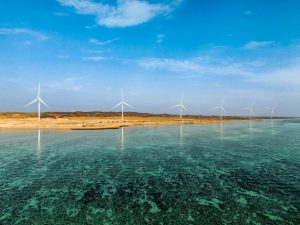
In spite of not having a support system for offshore wind development, Sweden is one of the leading offshore countries with an installed capacity of 133 MW.


Production targets

According to the new EU Renewables Directive, Sweden must supply 49% of its final energy consumption from renewable sources by 2020. In order to reach this goal, wind power development in Sweden must progress at a stronger rate than it has to date. This would require the removal of remaining barriers to wind development, such as the cumbersome permitting processes, the extensive appeals process and the lack of new grid construction.

The Swedish Wind Energy Association estimates that Sweden will need to increase its wind energy production from the current 2 TWh to around 20 TWh in order to reach the 2020 target. The corresponding installed capacity will have to be about 6-9 GW, of which 2-3 GW could be offshore wind power. Annual installations will need to reach an average of 500-700 MW, a figure that, according to the association, could comfortably be achieved.


Support system

In 2003, Sweden introduced a tradable green certificate support system, which gives producers of renewable electricity (wind, small hydro, biomass based CHP) economic support for every MWh they produce.

The current support system is designed to produce 17 additional TWh of renewable electricity by 2016, made up of 7-8 TWh of wind power, the same volume of biomass based CHP and about 2TWh of small hydro. The system encourages the cheapest means of production to be built first, which creates competition between wind, biomass and small hydro.

The Swedish system is a market based certificate programme in which the producer of renewable energy receives one certificate for every MWh of electricity produced. New production capacity can receive certificates for up to 15 years after production starts. After this time period, they are no longer eligible for additional certificates. The quota system has recently been extended to 2030 in order to give new generation capacity coming online in 2016 the ability to earn certificates for the maximum 15 years.

Utilities are required to meet a certain percentage of renewable energy by purchasing these certificates. Thus, market prices are set by the amount of certificates available and the amount of demand for these certificates.

On February 5, 2009, the coalition Government reached an internal agreement to promote renewable energy further. The target for the certificate system will be increased to 25 TWh by 2020, which will allow for some 15 TWh of onshore wind power to be built. In addition, the Government will develop a separate support system for offshore wind power.


The wind industry in Sweden

Sweden has no domestic wind turbine manufacturer. However, several Swedish companies produce and export various components, such as bearings, main shafts, generators and towers, to wind turbine manufacturers in Denmark, Germany and other countries. The total value of these exports is about 500 million Euros. ABB and SKF are well known examples of Swedish subcontractors.

Foreign companies are prominent in the Swedish wind power market and include Vestas (including two factories), Enercon (including tower manufacturing), Siemens, GE Wind, Suzlon and Nordex. WinWind of Finland has also entered the Swedish market through Dynavind, manufacturing towers.

Foreign developers and consulting companies have also established offices in Sweden, including Airtricity, RES, WPD, Statkraft among others.


Wind farms in Sweden

Sweden currently has six wind farms with an installed capacity of 15 MW or more in operation, with a further ten farms under construction, and an additional 18 large wind farms with all necessary permits in place. The expected electricity production from wind power is 3 TWh at the end of 2009 and 4 TWh at the end of 2010.

The largest operating wind farm in Sweden is Lillgrund with an installed capacity of 110MW. This offshore wind farm is owned by Vattenfall and has been operating since December 2007.

The largest onshore wind farm under construction is Havsnäs with an installed capacity of 96 MW, scheduled to be completed in 2010.


Wind farms in Sweden (over 15 MW)

In operation

Wind farm

Owner

TWh/year

MW


Bondön

Global Green Energy

0.08

35


Bliekevare

o2 Vindkompaniet

0.10

36


Saxberget

Stena Renewable Energy

0.11

34


Lillgrund

Vattenfall

0.33

110


Hedbodberget

Vindkompaniet

0.05

18

Säliträdberget

Vindkompaniet

0.05

16

Under construction

Wind farm

Owner

TWh/year

Planned completion

Uljabuouda

Skellefteå Kraft

0.085

2009

Laholm

Arise Windpower

0.072

2009

Dragaliden

Svevind

0.07

2008

Bliekevare

Vindkomapniet

0.1

2009

Gabrielsberget

Svevind

0.3

2009

Havsnäs

RES Skandinavien

0.23

2010

Storrun

DONG Energy/ Borevind

0.08

2009

Hedbodberget

Vindkompaniet

0.05

2009

Säliträdberget

Vindkompaniet

0.05

2009

Gässlingegrund

Vindpark Vänern

0.075

2008/2009

Hud/Kil

Rabbalshede Kraft

0.058

2009/2010

Brattön

Rabbalshede Kraft

0.06

2010-2012

Hörnefors

Umeå Energi

0.56

2009